Podbean Pricing: The Best Podcast Hosting Platform for Getting Started?
Podbean Pricing Plans (2026): Every Tier Compared
Click Here For Podbean Deals
Podbean is one of the longest-running podcast hosting platforms on the market, and its pricing has evolved to match how modern creators actually work. Whether you publish a solo audio show, run a video podcast, or manage a private internal feed for your company, there is a Podbean plan built for your workflow.
This guide breaks down every Podbean plan, what each tier includes, how the AI credit system works, and who each plan is best for—so you can pick the right one without overpaying. If you are still deciding between hosts, start with our broader podcast hosting comparison or our overview of the top paying podcasting platforms.
Podbean Pricing at a Glance (2026)
👉 Limited Deal: Risk-Free 30-Day Podbean Trial
Click Here For More Podbean Pricing
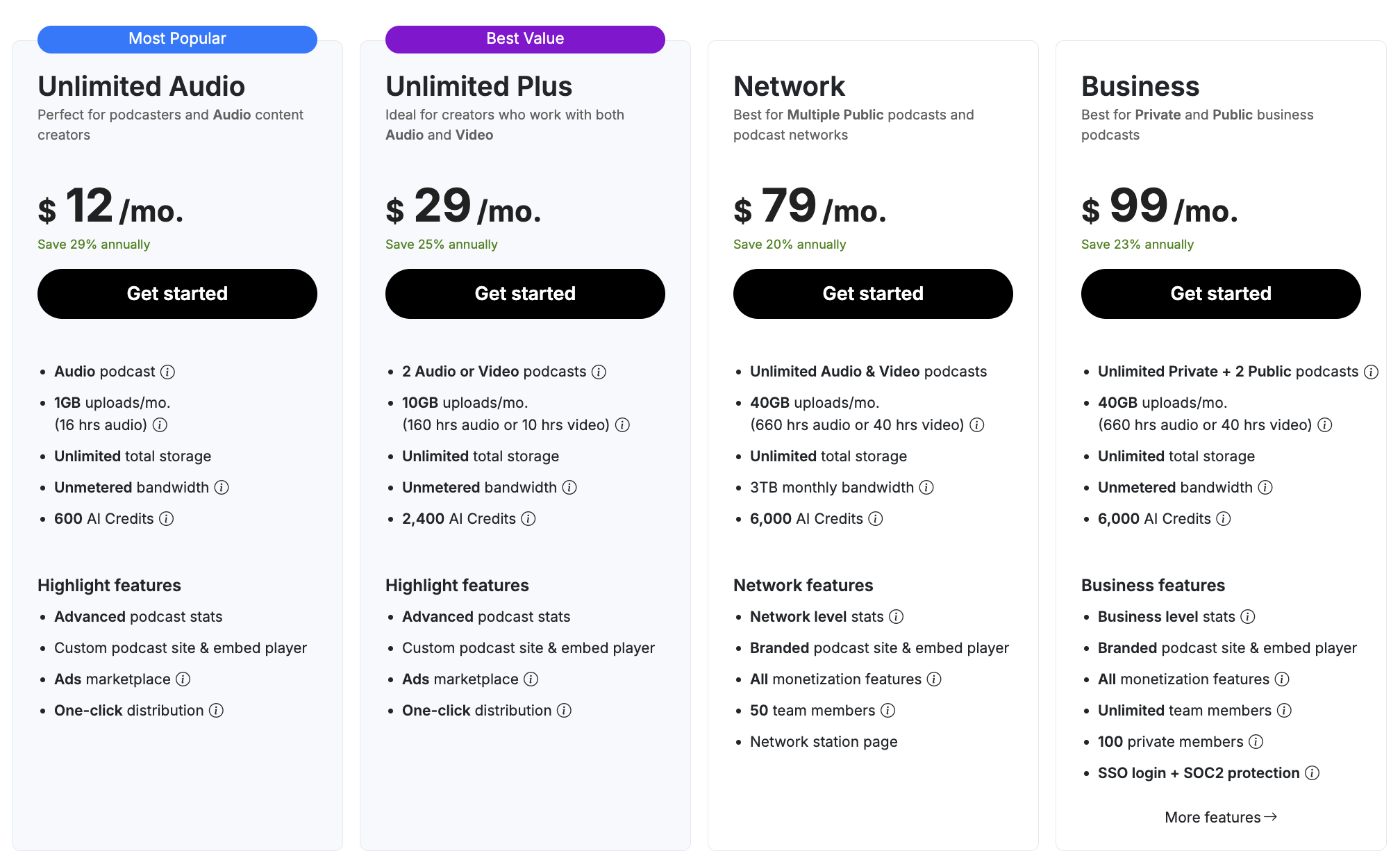
Podbean offers a free Basic tier plus four paid plans. All paid plans include unlimited total storage, a customizable podcast website, one-click distribution to major directories, and access to Podbean’s AI tools. Prices listed below reflect annual billing; monthly billing is also available at a higher rate.
| Plan | Annual Price | Monthly Price | Monthly Upload Limit | Channels | AI Credits/Mo. | Best For |
|---|---|---|---|---|---|---|
| Basic (Free) | $0 | $0 | 5 hrs / 100 GB bandwidth | 1 | — | Testing the waters |
| Unlimited Audio | $12/mo | $17/mo | 1 GB (~16 hrs audio) | 1 | 600 | Solo audio podcasters |
| Unlimited Plus | $29/mo | $39/mo | 10 GB (~160 hrs audio / ~10 hrs video) | 2 | 2,400 | Audio + video creators |
| Network | $79/mo | $99/mo | 40 GB (~660 hrs audio / ~40 hrs video) | Unlimited | 6,000 | Podcast networks |
| Business | $99/mo | $129/mo | 40 GB (~660 hrs audio / ~40 hrs video) | Unlimited private + 2 public | 6,000 | Private and internal podcasts |
All paid plans include unlimited total storage, unmetered bandwidth (Network is capped at 3 TB/month), advanced podcast analytics, and access to Podbean’s Ads Marketplace. You can upgrade or downgrade at any time—upgrades take effect immediately, and downgrades apply after your current billing cycle ends. For a detailed breakdown of how much it costs to start a podcast, our cost guide covers hosting alongside gear and software expenses.
Free Basic Plan
Podbean’s free tier lets you publish up to 5 hours of podcast content with 100 GB of monthly bandwidth, generate an RSS feed, and get a basic podcast website. It is designed for creators who want to test the platform before committing to a paid subscription. The free plan includes basic statistics, a custom embeddable player, and access to the Podbean mobile app for recording and publishing on the go. You do not get access to Podbean AI, monetization tools, advanced analytics, or the ability to map a custom domain on this tier.
One important caveat: once you upgrade to a paid plan, you cannot downgrade back to the free tier. If you are just getting started and want to compare free hosting options, check out our full guide to free podcast hosting. You can also explore how to start a podcast for free or see whether SoundCloud podcast hosting or Squarespace podcast hosting might be better free or low-cost alternatives for your situation. For podcasters migrating away from Spotify for Podcasters (formerly Anchor), our guide on what happened to Anchor and what to use instead of Anchor explains your options.
Unlimited Audio — $12/mo (Annual)
The Unlimited Audio plan is Podbean’s most popular tier and the entry point for creators who are serious about publishing consistently. At $12 per month on annual billing ($17 month-to-month), it gives you everything the free plan offers plus unlimited total storage, unmetered bandwidth, and access to the full Podbean feature set for a single audio podcast channel.
Your monthly upload limit is 1 GB, which translates to roughly 16 hours of audio content per month—more than enough for a weekly show. You also get 600 AI credits per month, advanced podcast statistics with listener location, device, and source breakdowns, episode trends and comparison tools, basic user engagement intel, and eligibility for the Ads Marketplace and Apple Podcasts Subscriptions integration.
PodAds dynamic ad insertion is available on this tier at $1 CPM. If you are looking for ways to monetize your podcast, this plan gives you the core tools to start earning through advertising and premium content. For additional monetization strategies, our guide on making real money in podcasting covers paths beyond traditional ads.
Who Should Choose Unlimited Audio?
This plan is ideal for solo creators running a single audio podcast who want professional-grade hosting with monetization options baked in. If you are producing a weekly show and want access to analytics that go beyond basic download counts, this is the sweet spot. For context on what kind of numbers matter, see our breakdown of podcast download numbers and what they actually mean, or use our podcast revenue calculator to estimate your earning potential.
If you are concerned about outgrowing a budget-friendly host, our post on hitting the limits of low-cost podcast hosting explains when it makes sense to upgrade.
Unlimited Plus — $29/mo (Annual)
The Unlimited Plus plan adds video podcast hosting and a much larger monthly upload limit. At $29 per month on annual billing ($39 month-to-month), you get 10 GB of uploads per month—enough for roughly 160 hours of audio or 10 hours of video—and can manage up to two podcast channels (audio or video) from a single account.
AI credits jump to 2,400 per month, giving you significantly more room for automated show notes, transcripts, chapter markers, and AI audio optimization. Like the Unlimited Audio plan, PodAds is available at $1 CPM, and you have full access to the Ads Marketplace and Apple Podcasts Subscriptions.
The key upgrade here is native video podcast support. Podbean’s Video to Podcast feature lets you auto-sync a YouTube playlist or video RSS feed and transform that content into podcast episodes. If you are already producing YouTube podcast content, this integration can save a lot of manual republishing work. For creators considering the shift to video, our post on whether video podcasts are back covers the strategic case.
Who Should Choose Unlimited Plus?
This plan fits creators who publish in both audio and video formats, or anyone who needs a second podcast channel without paying for a full network plan. It is also the right choice for podcasters who lean heavily on AI-assisted post-production—the 4x jump in AI credits from the Audio plan makes a meaningful difference if you are using transcription, chapter markers, and noise reduction on every episode. If you want to compare video-friendly platforms more broadly, see our guide to the best video podcast platforms. For remote recording workflows that complement Podbean’s hosting, check out our roundup of remote podcast recording software and our comparison of SquadCast vs. Zencastr.
Network Plan — $79/mo (Annual)
The Network plan is built for creators or organizations that manage multiple public podcasts under a single brand. At $79 per month on annual billing ($99 month-to-month), you get unlimited audio and video podcast channels, 40 GB of monthly uploads, 6,000 AI credits, and up to 50 team members with role-based access (owner, admins, channel-admins, analysts, and contributors).
This is also the first tier where PodAds dynamic ad insertion is included for free (lower plans pay $1 CPM). You get network-level analytics that aggregate performance data across all your shows, a branded network station page, full-customized embeddable players, live chat support, and the ability to remove Podbean branding from your site and players.
The one trade-off at this tier is bandwidth: the Network plan caps you at 3 TB per month rather than offering unmetered bandwidth. For most podcast networks, 3 TB is more than sufficient, but if you expect very high download volumes across many shows, it is worth keeping in mind.
Who Should Choose Network?
This plan is the right fit for podcast networks with multiple shows, media companies consolidating their audio content under one account, or prolific creators who run several feeds. If you are exploring the podcast network model, our guide on what to check before joining a podcast network covers the key considerations. You can also explore our directory of podcast networks for small podcasts to see what network affiliation options exist beyond self-hosting.
Business Plan — $99/mo (Annual)
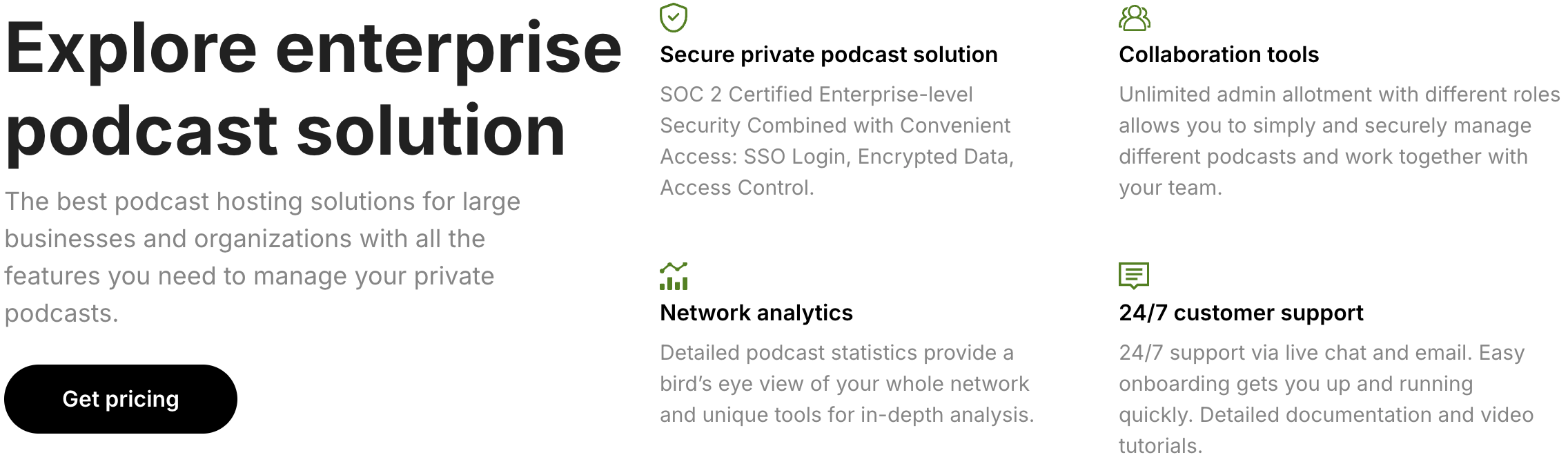
The Business plan is Podbean’s solution for organizations that need private podcast hosting alongside public feeds. At $99 per month on annual billing ($129 month-to-month), you get everything in the Network plan plus unlimited private podcast channels, unlimited team members, 100 private members (with the option to purchase more), SSO login integration, and SOC 2-certified data protection.
Bandwidth is unmetered on this tier (with premium bandwidth included), and user engagement analytics are upgraded to the Advanced level—giving you deeper insight into listener behavior including plays, skips, relistens, and consumption trends. The mobile app experience also upgrades to the Pro Podcast app, and you get live chat support.
For organizations with larger needs, Podbean offers custom Enterprise pricing with white-label app development, custom integrations, private groups, dedicated support, and development support for custom features. You can explore those options on their enterprise pricing page.
Who Should Choose Business?
This plan is designed for companies using podcasts for internal communication, employee training, onboarding, or client-facing private content. If you need access control, SSO, and compliance-grade security, this is the only standard Podbean plan that delivers all three. For a broader look at private and enterprise solutions, see our roundup of enterprise podcast solutions and our guide to private podcast platforms. If you want to explore setting up a private feed on a tighter budget first, we also cover how to make a private podcast for free.
👉 Limited Deal: Risk-Free 30-Day Podbean Trial
Full Feature Comparison by Tier
The pricing table above covers the headline numbers, but several features differ between tiers in ways that matter for day-to-day use. Here is how the details break down across all four paid plans.
| Feature | Unlimited Audio ($12/mo) | Unlimited Plus ($29/mo) | Network ($79/mo) | Business ($99/mo) |
|---|---|---|---|---|
| Audio Hosting | Yes | Yes | Yes | Yes |
| Video Hosting | No | Yes | Yes | Yes |
| Podcast Channels | 1 (add-on $) | 2 (add-on $) | Unlimited | Unlimited private + 2 public |
| Bandwidth | Unmetered | Unmetered | 3 TB/mo | Unmetered + premium |
| User Engagement Analytics | Basic | Basic | Basic | Advanced |
| Network-Level Analytics | No | No | Yes | Yes |
| PodAds (Dynamic Ad Insertion) | $1 CPM | $1 CPM | Free | Free |
| Embeddable Players | Customized | Customized | Full-customized | Full-customized |
| Mobile App | Podbean app | Podbean app | Podbean app | Pro Podcast app |
| Team Members | — | — | 50 | Unlimited |
| Remove Podbean Branding | No | No | Yes | Yes |
| Private Podcasting / SSO | No | No | No | Yes |
| Live Chat Support | No | No | Yes | Yes |
All four paid plans include advanced podcast stats, episode trends and comparison, Apple Podcasts Subscriptions integration, Ads Marketplace access, unlimited live streaming, RSS feed generation, one-click directory distribution, auto-sharing to social media, custom domain mapping, and a professional podcast website. For a closer look at how podcast analytics tools work across platforms, our roundup covers what metrics actually matter.
Podbean AI: How the Credit System Works
One of the most significant additions to Podbean in recent years is its built-in AI toolkit, which is available on all paid plans. Podbean uses a unified credit system—each plan includes a set number of AI credits per month, and credits are consumed at different rates depending on the tool you use.
There are three main categories of Podbean AI tools:
AI Audio Optimization uses 600 credits per hour of processed audio. This includes noise reduction, intelligent leveling, filler word and silence removal, and advanced filtering with AutoEQ. If you have been using external tools for silence removal or background audio removal, Podbean’s built-in option may simplify your workflow. For more on fixing bad audio, see our post on the tool that fixes bad audio and our guide to improving podcast sound quality.
AI Content Assistant uses 300 credits per hour of source audio. This generates automated episode titles, show notes, chapter markers, and AI-enhanced transcripts. For creators who want to improve discoverability, auto-generated show notes and transcripts tie directly into SEO for podcasters and the broader topic of whether podcast SEO is worth the effort. If you prefer to handle transcription outside Podbean, our guide to Podbean transcription explains your options, and our post on transcribing your podcast locally with OpenAI Whisper covers a free DIY alternative. You can also explore podcast transcription tools more broadly.
AI Podcast Creator uses 600 credits per hour and lets you turn text, files, blog posts, or ideas into fully produced podcast episodes. The companion Blog to Podcast feature auto-syncs your blog feed into AI Podcast Creator, which is a compelling option if you are already repurposing podcast content or want to go the other direction and turn written content into audio. For more on content repurposing workflows, see our guide on turning podcast audio into social media content and our overview of turning your podcast into passive income with AI.
AI credits reset monthly on your billing cycle date (at 00:00 GMT). If you need more than your plan includes, you can purchase additional credits through your account dashboard under Add-on Features. Credits are shared across all channels on your account, including channels managed by Company Admins and Channel Admins.
Here is a quick reference for how many episodes you can process per tier:
| Plan | AI Credits/Mo. | Audio Optimization (hrs) | Content Assistant (hrs) | AI Podcast Creator (hrs) |
|---|---|---|---|---|
| Unlimited Audio | 600 | 1 hr | 2 hrs | 1 hr |
| Unlimited Plus | 2,400 | 4 hrs | 8 hrs | 4 hrs |
| Network | 6,000 | 10 hrs | 20 hrs | 10 hrs |
| Business | 6,000 | 10 hrs | 20 hrs | 10 hrs |
Keep in mind that most creators use a mix of AI tools on each episode, so your actual throughput will depend on which features you apply. If you are comparing AI-assisted post-production options across platforms, our guide to the best podcast editing software and our overview of Castmagic pricing cover the alternatives.
Podbean Monetization Features
Podbean offers more built-in monetization pathways than most hosting platforms. Every paid plan includes access to three core revenue tools:
Ads Marketplace connects you with advertisers directly through Podbean. Your podcast must pass a content safety review to qualify, but once approved, you can earn through sponsorship placements without managing advertiser relationships yourself. For a broader look at how podcast advertising works, see our guides on how to get ads on your podcast, podcast advertising platforms, and making your niche podcast more attractive to advertisers. If you are curious about ad economics, our posts on how much podcast ads cost and how much podcasts make from ads break down the numbers.
PodAds (Dynamic Ad Insertion) lets you insert your own ads or sponsored content into episodes dynamically. On the Unlimited Audio and Unlimited Plus plans, this costs $1 CPM. On the Network and Business plans, PodAds is included for free. For more on structuring your show around advertising, see our episode on restructuring your podcast to be advertising-friendly.
Apple Podcasts Subscriptions integration lets you create and manage premium episodes for paying subscribers directly from the Podbean dashboard. This gives you a direct path to subscription revenue through Apple’s ecosystem without needing a separate membership platform. For more on premium content strategy, see our guide to podcast premium content.
Podbean also supports live streaming with virtual gifting and Fan Club memberships, which creates an additional income stream beyond traditional advertising. For more on live podcasting, see our guide to livestreaming platforms for podcasters and our episode on live podcasting. If you are weighing different platforms for podcast monetization, Podbean’s built-in options are among the most comprehensive available without third-party tools. For a complete overview of every revenue strategy available to podcasters, see our podcast money guide and our breakdown of how podcasters make money. You can also run the numbers through our podcast revenue calculator or Patreon fees calculator if you are considering a membership model alongside Podbean’s tools.
Podbean Analytics and Distribution
All paid Podbean plans include advanced podcast statistics with IAB-certified download tracking. You get breakdowns by listener location, device type, listening source, and episode-level performance trends. Episode trends and comparison tools let you track performance over time and compare episodes side by side. The Network and Business tiers add aggregated network-level analytics so you can track growth across multiple shows from a single dashboard, while the Business plan further upgrades user engagement intel to the Advanced level with play, skip, relisten, and consumption trend data.
For more on understanding your podcast data, see our guide to podcast analytics tools, our post on OP3 podcast analytics, and our episode on how listener data can improve your podcast.
Distribution is handled through one-click submission to Apple Podcasts, Spotify (audio only), Amazon Music, iHeartRadio, and the Podbean app. Episodes can be auto-shared to Facebook, LinkedIn, YouTube, Tumblr, and WordPress. For a deeper dive into getting your show listed everywhere, see our guide on how to upload your podcast to all platforms, our guide to getting on Spotify, and our post on how to distribute a podcast.
Each plan includes a customizable podcast website with your own domain mapping, an embeddable player, and an RSS feed for each podcast channel. If you need help setting up your feed, our guide on creating an RSS feed for a podcast and our RSS feed generator can help. If you are thinking about whether your podcast needs its own site beyond what Podbean provides, we cover that decision in detail in our post on why every business podcast needs its own website, our roundup of website builders for podcasts, and our look at what a Buzzsprout podcast website is and isn’t for comparison.
Podbean vs. Competitors: How Pricing Compares
Podbean sits in the mid-range of podcast hosting pricing, but its feature density—especially around monetization and AI—puts it ahead of many competitors at similar price points. Here is how it stacks up against the platforms podcasters most often compare it to.
| Feature | Podbean ($12/mo) | Buzzsprout ($12/mo) | Libsyn ($5–$20/mo) | Transistor ($19/mo) | Castos ($19/mo) |
|---|---|---|---|---|---|
| Unlimited Storage | Yes | No (3 hrs/mo) | Plan-dependent | Yes | Yes |
| Video Podcast Support | No (Plus plan+) | No | Yes (higher tiers) | No | Yes |
| Built-in Monetization | Ads Marketplace, PodAds, Apple Subs | Affiliate Marketplace | Libsyn Ads | No | No |
| AI Tools | Yes (600 credits/mo) | Limited (add-on) | No | No | Limited |
| Live Streaming | Yes (unlimited) | No | No | No | No |
| Multiple Podcasts | Add-on ($) | Add-on ($) | Separate plans | Included (unlimited) | Included (3+) |
| Private Podcasting | Business plan only | No | Yes | Yes | Yes |
For detailed pricing breakdowns of each competitor, see our individual guides: Buzzsprout pricing (also see Buzzsprout pricing plans), Transistor pricing, Acast pricing, Async (Podcastle) pricing, Castos pricing, StreamYard pricing, Zencastr pricing, and SquadCast pricing.
For a side-by-side look at Podbean specifically, we also have dedicated comparison posts for Podbean vs. Buzzsprout, Podbean vs. Libsyn, Podbean vs. Anchor, and Spreaker vs. Podbean. If you want even more hosting comparisons, check out Buzzsprout vs. Libsyn, Buzzsprout vs. Captivate, and Buzzsprout vs. Anchor.
Podbean Pros and Cons
What Podbean Does Well
All-in-one monetization. Few hosting platforms match Podbean’s built-in revenue tools. Between the Ads Marketplace, PodAds dynamic insertion, Apple Podcasts Subscriptions, and live streaming with virtual gifting, you can pursue multiple income streams without leaving the platform. For more on the full spectrum of how podcasters make money, we cover every major path in our monetization guide. You can also check our post on Spotify podcast monetization and how to monetize with Acast to see how other platforms compare on the revenue side.
AI-powered post-production. The integrated AI tools for noise reduction, leveling, filler word removal, transcription, show notes, and chapter markers are a genuine time-saver. Competing platforms either lack these features entirely or charge separately for them. If you are evaluating your editing workflow more broadly, our guide to the best podcast editing software and our overview of podcast editing software cover the full landscape.
Flexible plan structure. The tiered approach—from a free starter plan through enterprise-grade private hosting—means you do not have to switch platforms as your podcast grows. You can start on the Unlimited Audio plan and scale up to Network or Business without migrating your content.
Reliable uptime and distribution. Podbean includes a global CDN, one-click distribution to every major directory, and auto-sharing to social platforms. For a broader look at how hosting platforms handle distribution, see our podcast hosting platforms comparison and our guide to easy podcast hosting. If you are also exploring the hosting ecosystem, our guide to Anchor podcast hosting explains where Spotify for Podcasters fits in the landscape today.
Where Podbean Falls Short
Upload limits are measured in GB, not hours. While Podbean provides approximate hour equivalents, the 1 GB monthly limit on the Unlimited Audio plan can feel restrictive for creators who produce long-form content or record at higher bitrates. Podcasters who care about audio quality settings should review our post on podcasting bitrate to understand how file size and quality interact, and our guide to the best audio format for podcasts for format recommendations.
Website customization has limits on lower tiers. Podbean’s built-in podcast website is functional but not as flexible as a full WordPress site. Customization improves on higher tiers, and you can map your own domain on any paid plan, but if web design control matters to you, a dedicated podcast website builder or WordPress podcast setup may serve you better. For more website options, see our podcast website examples and our podcast website checklist.
No downgrade path back to free. Once you move to a paid plan, you cannot return to the free tier. This is worth knowing before you commit, especially if you are still in the experimentation phase.
Video distribution is Spotify audio-only. While Podbean supports video hosting on the Unlimited Plus plan and above, Spotify distribution is currently audio-only. If your primary strategy is getting your podcast on Spotify with video, this is a limitation to weigh against other video podcast platforms.
No built-in remote recording. Unlike platforms such as Riverside or SquadCast, Podbean focuses on hosting and distribution rather than multitrack recording. If remote interviews are central to your workflow, you will need a separate tool. Our comparisons of SquadCast vs. Riverside and remote video recording software can help you choose the right companion tool.
How to Get Started with Podbean
Signing up for Podbean starts with a free account. From there, you can explore the dashboard, set up your RSS feed, and publish a few test episodes before deciding on a paid plan. If you are migrating from another host, Podbean offers free import via RSS feed on all plans.
For creators who are still in the planning phase, our starting a podcast checklist walks through everything you need to have in place before launch. See also our guides on how to start a successful podcast, how to start a podcast with no audience, and 5 podcast launch mistakes to avoid. If you need help with the gear side, our podcast equipment guide covers microphones, interfaces, headphones, and recording setups at every budget level. For more targeted equipment recommendations, check out our guides to recording equipment for solo podcasters, equipment for co-hosts and groups, best cheap podcast microphones, and best podcast headphones. You can also explore our full directory of podcast tools for software recommendations across every stage of your workflow.
Frequently Asked Questions
Is Podbean free?
Yes. Podbean offers a free Basic plan with 5 hours of upload space, 100 GB monthly bandwidth, basic statistics, and a simple podcast website. It is a good way to test the platform, but it does not include AI tools, monetization features, or advanced analytics. Keep in mind that once you upgrade to a paid plan, you cannot downgrade back to free.
How much does Podbean cost per month?
Podbean’s paid plans start at $12 per month on annual billing for the Unlimited Audio plan. Monthly billing starts at $17 per month. The most expensive standard plan is the Business tier at $99 per month on annual billing ($129 monthly). Custom enterprise pricing is also available for organizations that need white-label apps, custom development, and dedicated support.
Can I switch Podbean plans later?
Yes. You can upgrade or downgrade between paid plans at any time. Upgrades take effect immediately, while downgrades apply after your current billing cycle ends. Annual subscriptions include a discounted rate compared to monthly billing.
Does Podbean support video podcasts?
Yes, starting with the Unlimited Plus plan ($29/mo annual). The Unlimited Audio plan is audio-only. Video to Podcast functionality lets you auto-sync YouTube playlists into podcast episodes. For more on video podcasting, see our guide to the best video podcast platforms and our episode on whether video podcasts are back.
What are Podbean AI credits?
Podbean AI credits are a unified currency for using Podbean’s built-in AI tools, including audio optimization (600 credits/hr), content generation like show notes, titles, transcripts, and chapters (300 credits/hr), and AI Podcast Creator (600 credits/hr). Each plan includes a set number of credits per month (600 to 6,000 depending on your tier), credits reset monthly on your billing cycle date, and you can purchase additional credits if needed. Credits are shared across all channels on your account.
Does Podbean offer private podcasting?
Yes, but only on the Business plan ($99/mo annual) and Enterprise plans. Private podcasting includes access control, SSO login, SOC 2-certified security, private groups, and private member management. For a broader comparison, see our guide to the best private podcast platforms and our overview of enterprise podcast solutions.
How does Podbean compare to Buzzsprout?
Both platforms are popular choices for podcast hosting. Podbean offers more built-in monetization tools and AI features, while Buzzsprout is known for its simplicity and beginner-friendly interface. Podbean includes unlimited storage on all paid plans; Buzzsprout limits upload hours by tier. For a detailed comparison, see our Podbean vs. Buzzsprout breakdown. You can also compare Buzzsprout pricing side by side, or read our take on whether Buzzsprout is the right choice.
Can Podbean help me make money from my podcast?
Yes. Podbean includes an Ads Marketplace for sponsorship revenue, PodAds for dynamic ad insertion, Apple Podcasts Subscriptions for premium content, and live streaming with virtual gifting. These tools are available on all paid plans, though PodAds is only free on Network and Business tiers (lower plans pay $1 CPM). For a complete overview of podcast revenue strategies, see our guide on whether you can make money from a podcast and our podcast money guide.
How does Podbean compare to Libsyn?
Podbean and Libsyn are both established podcast hosting platforms, but they take different approaches. Podbean offers unlimited storage on all paid plans and includes AI tools at every tier, while Libsyn uses storage-based pricing without built-in AI. Podbean’s monetization suite is more comprehensive, with Ads Marketplace, PodAds, Apple Podcasts Subscriptions, and live streaming. Libsyn offers its own ad marketplace and supports video on higher tiers. For a full breakdown, see our Podbean vs. Libsyn comparison.
Does Podbean include transcription?
Yes. Podbean’s AI Content Assistant generates AI-enhanced transcripts as part of the credit system (300 credits per hour of source audio). This is included on all paid plans. For more details, see our guide to Podbean transcription and our broader overview of podcast transcription options.
Get Started with Podbean Today – Try It Risk-Free
Final Verdict
Podbean remains one of the strongest all-in-one podcast hosting platforms available in 2026. Its combination of unlimited storage, built-in monetization, AI-powered post-production, and live streaming capabilities makes it particularly compelling for creators who want to consolidate their toolkit into a single platform rather than stitching together multiple services.
The Unlimited Audio plan at $12/month (annual) is the right starting point for most solo audio podcasters. If you also produce video content, the Unlimited Plus plan at $29/month adds that capability without a steep jump in price. Podcast networks should look at the Network plan at $79/month, and organizations needing private feeds with enterprise-grade security will find those features exclusively on the Business plan at $99/month.
If you are still weighing your hosting options, start with our broader comparison of podcast hosting platforms, check out our podcast hosting platforms overview, or jump straight into our podcast tools directory to see how hosting fits into the bigger picture of your production workflow.
- The Ultimate Guide to Choosing Cameras and Lenses for Podcasting
- StreamYard Business Plan Review: Is It Worth $299/Month for Teams?
- Synology DS1525+ for Podcasters: What You Need to Know Before You Buy
- StreamYard Pricing (2026): Full Comparison of Plans, Differences, Features & Discounts
- Podbean Pricing: The Best Podcast Hosting Platform for Getting Started?