Sony MDR-7506 Review: The Best Podcasting Headphones?
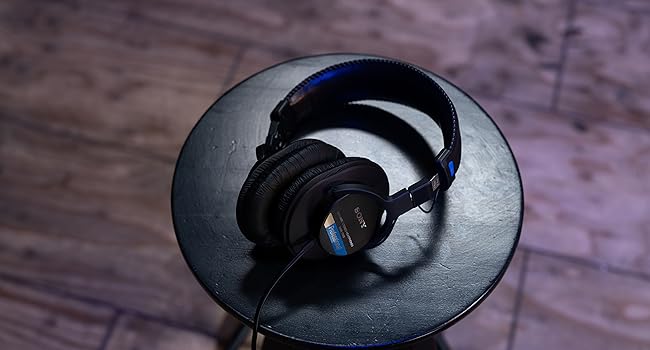
Yes — the Sony MDR-7506 remains the best studio monitoring headphones for podcasters under $100 in 2026. Their flat frequency response makes dialogue editing accurate and reliable, their closed-back design blocks ambient noise during recording, and their build quality means a single pair lasts years. The main limitations are the fixed coiled cable, no Bluetooth, and no active noise cancellation — none of which matter for studio or home editing use.
I’ve used the MDR-7506 in my own podcast production setup for years. They’re on my desk for every editing session, paired with my audio interface for monitoring during recording, and the pair I have now replaced a set I wore through completely — not because they broke, but because the ear pads finally gave out after enough hours that I felt good about the investment. Here’s the full picture.
Check the current price on Amazon
[youtube-embed]
Quick Verdict
| Buy the MDR-7506 If… | Skip It If… |
|---|---|
| You edit dialogue, interviews, or spoken-word audio | You need Bluetooth or active noise cancellation |
| You record in a home or treated studio | You prefer a detachable or shorter cable |
| You want neutral, accurate playback for mixing | You listen primarily to bass-heavy music |
| You need long-session comfort without fatigue | You need wireless for commuting or travel |
Bottom line: The MDR-7506 is the most dependable studio monitoring headphone under $100. Neutral, durable, and accurate — everything a podcaster needs for editing and monitoring, nothing superfluous.
Who I Am and Why I Trust These Headphones
I’ve been producing audio content since 2015. The MDR-7506 became my primary editing headphones because of what they reveal rather than what they hide. Unlike consumer headphones that boost bass and treble to make music sound exciting, the MDR-7506 shows you your audio as it actually is — which means problems in your recording are immediately obvious and fixable before you publish. For podcasters, that’s the only thing that matters in a monitoring headphone.
These are the headphones I reach for when I’m editing interviews, checking mic placement, or troubleshooting noise in a recording. They’re paired with my audio interface and used alongside the microphones and recording setup I cover in the podcast microphone setup guide.
Sound Quality: Flat, Accurate, Honest
The defining characteristic of the MDR-7506 is its flat frequency response. There is no artificial bass boost, no hyped treble, no “exciting” coloration designed to make music feel dramatic. You hear your recording exactly as it was captured — which is exactly what you need when editing speech.
In practical terms, this means dialogue comes through crisp and unadorned. Sibilance (the harsh “s” sounds that plague poor mic technique) is immediately obvious. Plosives from missed pop filter placement jump out. Breaths, room tone, and background hum are all audible at their true level. None of this is pleasant, but all of it is useful — you catch problems before your listeners do.
The slight brightness in the upper-mid range actually serves podcast editing well. Consonants and transients in speech cut through clearly, making it easy to identify exactly where edits should land. For music production, some engineers find this brightness tiring over long sessions; for voice content, it’s an asset. See our best audio format for podcasts guide for how monitoring accuracy connects to your final export settings.
Noise Isolation: Closed-Back Does the Job
The MDR-7506 uses passive closed-back isolation — no electronics involved. The sealed earcups create a physical barrier between your ears and the room. In my home studio, keyboard clicks, HVAC hum, and ambient room noise essentially disappear once audio is playing at a reasonable listening level.
This matters for two reasons. First, when you’re editing, you want to hear your audio without room contamination. Second, when you’re monitoring during a live recording session, headphone bleed — the sound leaking from your headphones back into your open mic — can ruin a take. The MDR-7506’s seal keeps bleed minimal even at higher monitoring volumes.
They are not active noise-canceling headphones. For commuting, airplane travel, or editing in a loud coffee shop, ANC headphones will outperform them. For studio and home recording use, passive isolation is sufficient and actually preferable — ANC introduces phase artifacts that can subtly color what you hear. See our full guide on whether you need headphones for podcasting if you’re still deciding.
Build Quality and Longevity
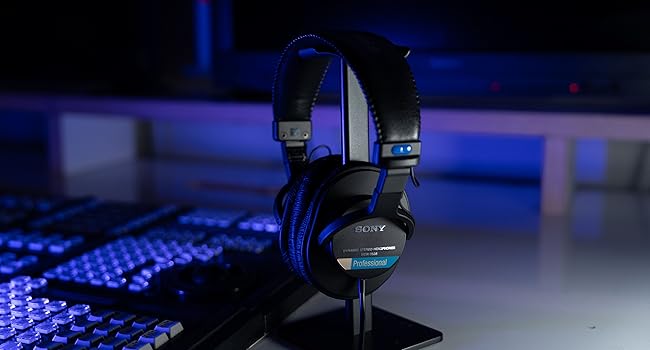
The MDR-7506 was designed for broadcast and studio professional use — environments where gear is used daily, packed and unpacked constantly, and expected to last years without failing. The build reflects that. The metal headband provides enough rigidity to maintain shape without adding unnecessary weight. The folding hinge is smooth and holds its position reliably. The coiled cable resists tangling and has survived more desk chair wheel encounters than I can count.
The ear pads will eventually wear — the pleather softens, compresses, and peels with enough use. Sony and third-party suppliers sell replacement pads for under $20, and swapping them takes about two minutes. Nearly every serviceable component is available as a replacement part, which is increasingly rare in consumer audio hardware. Engineers who bought their MDR-7506 in the 2010s are still using the same pair today.
Weight is 230g — light enough that you forget you’re wearing them during long sessions. The clamp force is slightly firm out of the box, which some users find uncomfortable initially, but it loosens naturally with a few weeks of use.
Common Drawbacks
| Issue | Why It Matters | Workaround |
|---|---|---|
| Fixed coiled cable | Can’t be replaced if it fails; limits portability | Use a short extension cable at the desk; coil keeps it from tangling |
| No Bluetooth or ANC | Not suitable for travel or noisy open-plan environments | Use a separate pair for travel; MDR-7506 stays at the desk |
| Firm initial clamp | May cause pressure discomfort in the first weeks | Loosens naturally with use; or gently stretch the headband |
| Pleather ear pads degrade over time | Seal and comfort eventually diminish | Replacement pads are cheap and easy to install |
Sony MDR-7506 vs Alternatives
| Feature | Sony MDR-7506 | Audio-Technica ATH-M50x | Beyerdynamic DT-770 Pro |
|---|---|---|---|
| Sound signature | Flat / neutral | Slight bass and low-mid boost | Spacious, slightly bright |
| Best use case | Podcast editing, voice monitoring | Music production, general use | Long sessions, classical / orchestral |
| Comfort | Light, slightly firm clamp | Plush pads, more comfortable out of box | Softest overall; excellent for long sessions |
| Portability | Foldable | Foldable | Not foldable |
| Cable | Fixed coiled | Detachable (major advantage) | Fixed coiled (80-ohm version) |
| Price (USD) | ~$99 | ~$149 | ~$169 |
| Verdict for podcasters | Best value for voice editing | Better all-rounder; pricier | Best comfort; overkill for voice-only work |
The ATH-M50x is the most common alternative recommendation, and it’s a legitimate choice — especially for podcasters who also produce music. The detachable cable is a genuine advantage the MDR-7506 lacks. The M50x’s slight bass boost can, however, mask low-frequency problems in recordings that the MDR-7506 would surface immediately. For pure podcast editing, the MDR-7506’s neutrality wins at $50 less.
The Beyerdynamic DT-770 Pro is excellent but bulkier, non-foldable, and optimized for longer-form listening rather than the precise edit-point work that podcast production demands. It’s better for music engineers who double as podcasters than the reverse.
For a broader look at all categories including wireless and budget options, see our best podcast headphones guide.
Podcasting Use Cases: Where the MDR-7506 Excels
Editing interviews and dialogue: The flat response means you hear breath noise, mouth sounds, room tone, and plosives at their true level. Problems you might miss on consumer headphones will be obvious on the MDR-7506 — which means you fix them before publishing. Pair with your DAW of choice; see best podcast editing software for options at every level.
Monitoring during recording: The closed-back seal keeps headphone bleed out of your microphone during live sessions. If you’re recording with a dynamic mic like the Rode PodMic or a condenser, monitoring with the MDR-7506 gives you an accurate picture of what’s being captured without affecting what the mic picks up. See the microphone setup guide and solo podcaster recording equipment for full chain setups.
Checking your mix before export: The MDR-7506 is widely used as a “reality check” reference in broadcast and post-production. If your mix sounds good on these, it will translate well to earbuds, car speakers, and smart speakers — the devices your listeners actually use. This is the core professional use case that has kept them in broadcast booths at NPR, the BBC, and hundreds of independent production houses for decades.
Remote and co-hosted sessions: When recording remotely via remote recording software, the MDR-7506 gives you accurate monitoring of both your local mic and the return signal from your guest — helping you catch quality issues in real time rather than in post. See also equipment for co-hosts and groups for full dual-mic setups.
Voice-over and narration: The MDR-7506 reveals subtle EQ issues, subtle compression artifacts, and proximity effect buildup that consumer headphones mask. For voice-over work where tonal consistency across a long recording matters, these headphones are a reliable reference point.
How the MDR-7506 Fits in a Full Podcast Setup
The MDR-7506 is the monitoring layer in your signal chain — it doesn’t generate audio, it evaluates it. A complete home podcast setup pairs these headphones with a quality microphone, an audio interface (for XLR mics), and editing software. See:
- Complete podcast equipment guide
- Best audio interfaces for podcasting — the MDR-7506 connects via standard 3.5mm (¼” adapter included) to any interface headphone output
- Best podcast microphones for what to pair them with
- Podcast equipment bundles for starter kit recommendations
If you’re building a home studio from scratch and want to know how the MDR-7506 fits into a professional-grade setup, the Joe Rogan podcast studio breakdown shows how top-tier setups approach monitoring at every level.
Industry Trust: Why These Headphones Have Lasted 30+ Years
The Sony MDR-7506 was introduced in 1991 and has remained in continuous production since. That’s not nostalgia — it’s utility. Broadcast engineers at NPR, the BBC, and major post-production houses have used them as standard reference headphones for decades, not because they’re cheap, but because their consistency makes them a reliable reference point across teams and sessions.
User ratings consistently sit around 4.8/5 across Amazon, Sweetwater, and B&H Photo. The professional consensus is consistent: if your mix sounds good on the MDR-7506, it will sound good everywhere.
Frequently Asked Questions
Are the Sony MDR-7506 good for podcasting?
Yes — they’re one of the best headphones for podcast production specifically. Their flat frequency response makes dialogue editing accurate, their closed-back design prevents mic bleed during recording, and their build quality supports daily professional use. The MDR-7506 is used in broadcast studios worldwide for the same reasons they work for home podcasters.
How do the Sony MDR-7506 compare to the Audio-Technica ATH-M50x?
The MDR-7506 has a flatter, more neutral response — better for catching voice recording problems during editing. The ATH-M50x has a slight bass boost that makes it more enjoyable for general listening and music production, plus a detachable cable the MDR-7506 lacks. For podcast editing specifically, the MDR-7506’s neutrality is a meaningful advantage. The ATH-M50x costs about $50 more.
Do the Sony MDR-7506 work with audio interfaces?
Yes. They use a standard 3.5mm plug with a ¼” (6.35mm) screw-on adapter included, which connects to any standard headphone output on an audio interface. Compatible with Focusrite Scarlett, MOTU, Universal Audio, Zoom PodTrak, RødeCaster, and every other common podcast interface. See best audio interfaces for podcasting for pairing options.
Are the Sony MDR-7506 comfortable for long editing sessions?
Yes for most people, with one caveat. The initial clamp force is firm out of the box and can cause some pressure discomfort in the first few weeks. This loosens naturally with use. Once broken in, the lightweight design (230g) makes them comfortable for 2–3 hour editing sessions. The pleather ear pads eventually wear and should be replaced every 12–18 months under heavy use — replacement pads are cheap and widely available.
Do the Sony MDR-7506 have active noise cancellation?
No. They use passive closed-back isolation — the sealed earcups physically block ambient sound without electronics. Passive isolation is sufficient for home studio and treated room use. It will not block enough noise for editing in loud open-plan offices or while commuting. If you need ANC, the MDR-7506 is not the right headphone for those environments.
What is the impedance of the Sony MDR-7506 and does it matter?
The MDR-7506 has an impedance of 63 ohms — higher than typical consumer headphones (usually 16–32 ohms) but low enough to drive adequately from any audio interface, mixer headphone output, or computer. You do not need a dedicated headphone amplifier. They will also work plugged directly into a phone or laptop, though volume may be lower than with an interface.
How long do the Sony MDR-7506 last?
With normal professional use, the driver units last indefinitely — there are working pairs from the 1990s still in service. The consumable components are the ear pads (typically 1–2 years of heavy daily use) and the cable (which is fixed and not replaceable without soldering). The cable is the single failure point to watch; treat it carefully at the connector junction.
Is the Sony MDR-7506 still worth buying in 2026?
Yes. At roughly $99, nothing in the closed-back monitoring headphone category offers comparable neutrality and durability. The lack of Bluetooth and ANC are real limitations for portable use, but for the studio and home editing use case the MDR-7506 was designed for, they remain the best value option available. Competitors in the same price range compromise either sound accuracy or build quality; the MDR-7506 compromises neither.
Can I use the Sony MDR-7506 for music production as well as podcasting?
Yes, though with the awareness that their flat response will reveal mix issues rather than flatter them. Many mix engineers use them as a secondary “reality check” reference alongside a pair with more frequency emphasis. For music-first production where enjoyable monitoring matters alongside accuracy, the ATH-M50x or DT-770 Pro may serve better. For spoken-word production — podcasts, audiobooks, voice-over — the MDR-7506’s neutrality is the right tool.
What headphones do professional podcast studios use?
The Sony MDR-7506 is one of the most common choices in professional podcast and broadcast studios alongside the Audio-Technica ATH-M50x and Beyerdynamic DT-770 Pro. High-end studios may use Sennheiser HD 25 or AKG K702 for mixing. For monitoring during recording (rather than mixing), the MDR-7506 and ATH-M50x are the most widely deployed options at professional facilities. See best podcast headphones for the full category breakdown.
Final Verdict: Best Monitoring Headphones for Podcasters Under $100
The Sony MDR-7506 has been the professional standard for monitoring headphones for over 30 years, and nothing in 2026 has replaced them in their specific use case: accurate, neutral, closed-back monitoring for voice and dialogue editing.
They are not the most comfortable headphones out of the box. They don’t have Bluetooth. The cable is fixed. None of that matters for what they’re actually used for — sitting at a desk, editing audio, catching problems before your audience hears them.
At roughly $99, the MDR-7506 is a one-time purchase that will outlast several pairs of less-durable alternatives. For any podcaster serious about their audio quality, they belong in the setup.
Check the current price on Amazon
For the complete setup around these headphones, see the podcast equipment guide, what equipment is needed for a podcast, and podcast equipment bundles.