The Best Audio Interfaces That Will Instantly Upgrade Your Podcast
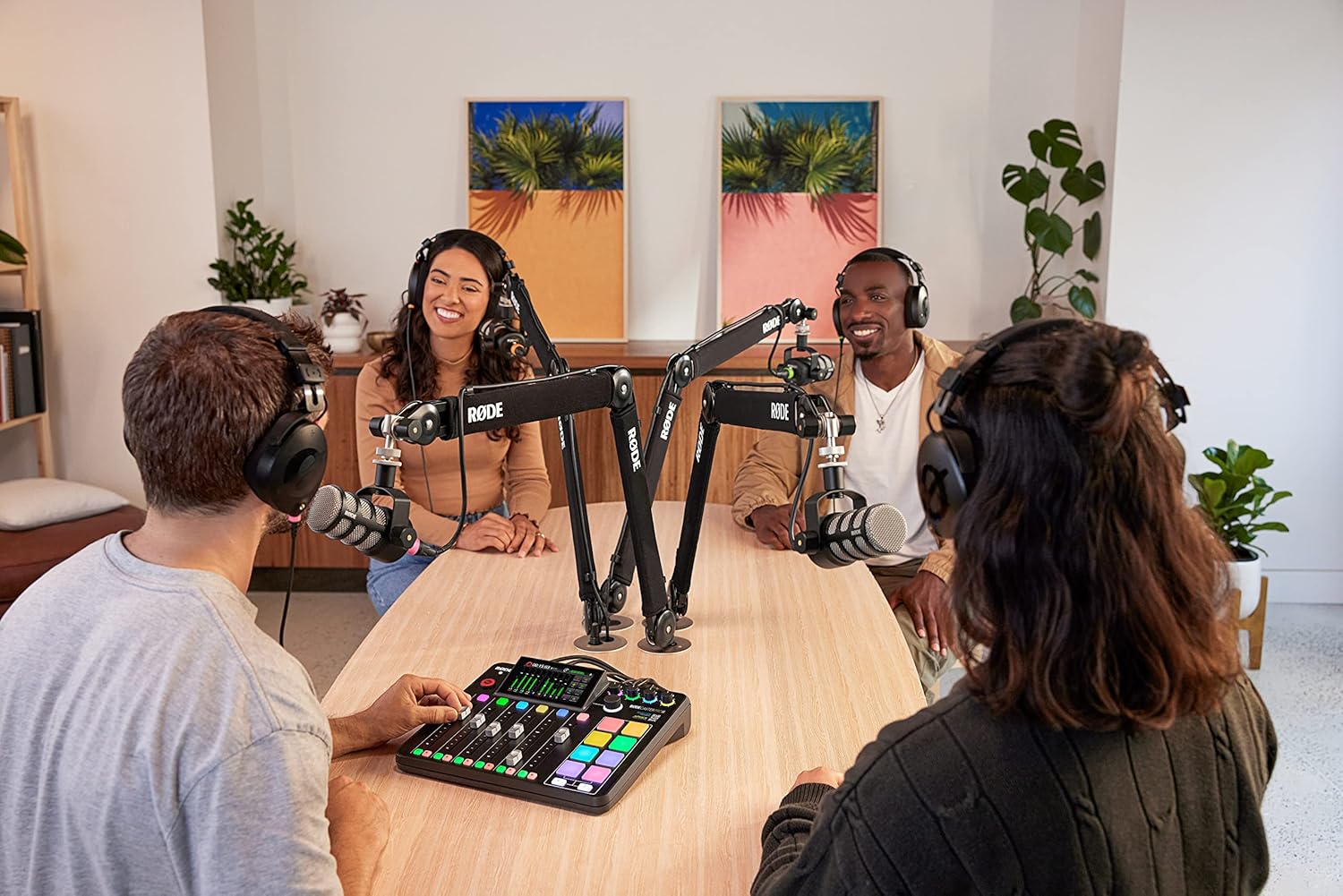 → See the RØDECaster Pro II — Our Top Pick for Serious Podcasters
The best audio interface for most podcasters is the Focusrite Scarlett 2i2 4th Gen ($179) — it delivers clean preamps, Auto Gain, and loopback in a bus-powered unit that works out of the box. If you’re running a solo show with an XLR mic, it’s the right choice at the right price. Need more inputs or podcast-specific features? This guide walks through every tier, from budget to broadcast-grade, matched to your exact setup.
I’ve been podcasting since 2015 and run my studio off XLR mics routed through a proper interface — not a USB mic plugged straight into a laptop. The difference in audio quality is immediately audible, and it’s the single biggest upgrade most podcasters skip. Here’s what actually matters when choosing one.
What Is an Audio Interface and Do You Actually Need One?
An audio interface converts the analog signal from your XLR microphone into a clean digital signal your computer can record. It also provides the microphone preamps (to boost gain), phantom power (for condenser mics), and zero-latency headphone monitoring that your laptop’s built-in sound card simply cannot match.
If you’re using a USB microphone, you technically don’t need an interface — the mic handles conversion internally. But the moment you want to use an XLR microphone, record multiple voices, or eliminate the hiss and noise floor baked into consumer audio hardware, an interface becomes essential.
Related: Podcast Microphone Setup Guide | Home Podcast Setup
Quick Picks: Best Audio Interfaces for Podcasting by Use Case
| Use Case | Best Pick | Price |
|---|---|---|
| Best Overall | Focusrite Scarlett 2i2 4th Gen | ~$179 |
| Best Budget | Audient iD4 MkII | ~$99 |
| Best for Two Hosts | Focusrite Vocaster Two | ~$299 |
| Best Portable (4 Mics) | Zoom PodTrak P4 | ~$199 |
| Best All-in-One Studio Hub | RØDECaster Pro II | ~$699 |
| Best for Large Panels (8 Mics) | Focusrite Scarlett 18i20 | ~$499 |
| Best Pro Studio Sound | UA Apollo Twin X | ~$899+ |
How Many Inputs Do You Actually Need?
This is the most important decision you’ll make — and most buyers get it wrong by under-buying or over-buying. Here’s the simple breakdown:
- Solo show: 1 input is enough. 2 gives you flexibility for a guest mic or instrument.
- Interview / co-host show: Minimum 2 XLR inputs. If you record guests in the same room, you need one input per person.
- Panel discussions or roundtables: 4–8 inputs. Look at the Zoom PodTrak P4 (budget) or RØDECaster Pro II (pro).
- Large studio productions: 8+ inputs via the Scarlett 18i20 or units with ADAT expansion.
Pro tip: Buy one input tier above where you are now. Upgrading your interface later is more expensive and disruptive than spending $50 more upfront. See our podcast equipment guide for co-hosts and groups for more.
The Best Audio Interfaces for Podcasting: Full Reviews
1. Focusrite Scarlett 2i2 4th Gen — Best Overall
The Scarlett 2i2 is the world’s best-selling audio interface for good reason. The 4th generation added features podcasters specifically asked for: Auto Gain (it sets your recording level automatically), Clip Safe (prevents distortion from unexpected loud moments), and three preamp modes — Clean, Air (adds presence), and Drive (adds warmth). At 69 dB of gain, it comfortably powers dynamic mics like the Shure SM7B without a Cloudlifter.
Best for: Solo podcasters and two-person shows who record locally and want professional sound with minimal fuss.
Pros: Industry-standard reliability, excellent preamps for the price, loopback for capturing computer audio, bus-powered via USB-C, works on Mac and Windows out of the box.
Cons: No onboard mixing or sound pads, no SD card recording, not ideal for 3+ person shows.
Price: ~$179 | Check current price on Amazon
2. Audient iD4 MkII — Best Budget Pick
The iD4 MkII punches well above its price point with a genuine console-grade preamp derived from Audient’s professional mixing desk heritage. It has a single XLR input, which is all most solo podcasters need. The scroll-wheel control is smooth and intuitive, and the converters are cleaner than most interfaces in this price range.
Best for: Solo podcasters who want better-than-Scarlett preamp quality at a budget price.
Pros: Excellent preamp quality, class-leading converters for the price, includes JFET instrument input, bus-powered.
Cons: Single XLR input only, no loopback functionality, limited podcast-specific features.
Price: ~$99 | Check current price on Amazon
3. Focusrite Vocaster Two — Best for Two-Host Shows
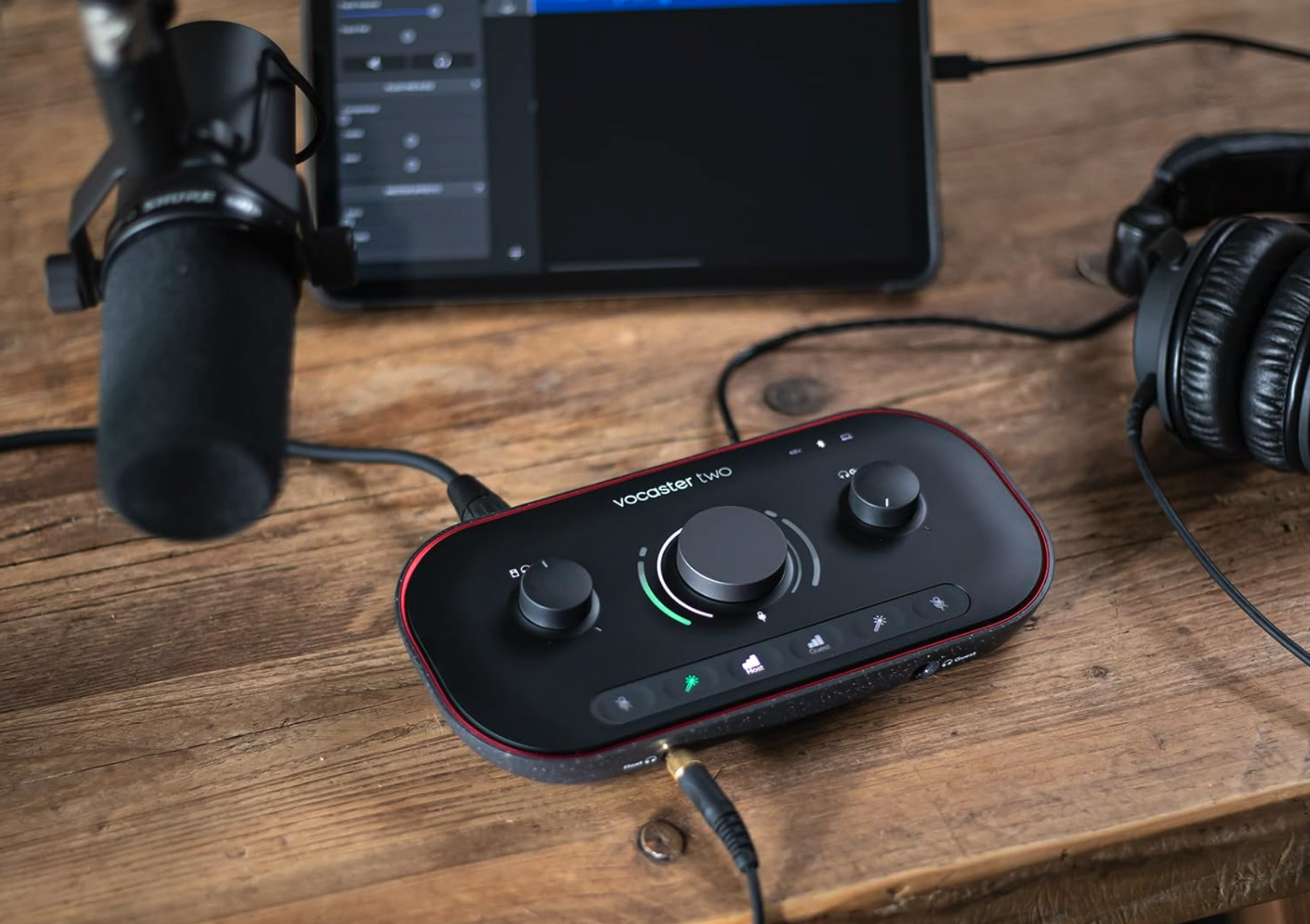
Focusrite designed the Vocaster series specifically for podcasters — not musicians who podcast. The Vocaster Two has two XLR inputs with independent controls, Auto Gain on both channels, Bluetooth integration (so a phone call goes directly into your mix), loopback for capturing remote guests, and a camera output for video podcasting. It’s purpose-built in a way the Scarlett line isn’t.
Best for: Two-person podcast setups, interview shows, creators who also record video.
Pros: Podcast-specific feature set, Bluetooth/phone integration, auto gain on both channels, includes Hindenburg and SquadCast licenses, camera output for video workflows.
Cons: Pricier than Scarlett 2i2 for similar input count, limited to 2 XLR inputs.
Price: ~$299 | Check current price on Amazon
Also see: Podcast Setup for Two Hosts
4. Zoom PodTrak P4 — Best Portable 4-Input Option
The PodTrak P4 is uniquely suited to multi-person podcasting on a budget. Four XLR inputs, sound pads for jingles and sponsor drops, built-in mix-minus (so remote guests don’t hear themselves echoed back), and SD card recording that works without a computer. It runs on AA batteries, making it genuinely portable for live events and on-location recording.
Best for: Podcasters recording 3–4 people in the same room, mobile recording, live events.
Pros: 4 XLR inputs at a budget price, mix-minus built in, battery-powered, sound pads, SD card recording, headphone output per channel.
Cons: Plastic build feels less premium, preamps are adequate but not exceptional, 16-bit recording vs. 24-bit on studio interfaces.
Price: ~$199 | Check current price on Amazon
Also see our full Zoom PodTrak P4 review.
5. RØDECaster Pro II — Best All-in-One Studio Hub
The RØDECaster Pro II is the interface I point to when someone says they want a proper podcast studio in a single unit. Four Revolution Preamps with 76 dB of gain (more than enough for any dynamic mic), APHEX processing onboard (Aural Exciter, Big Bottom, compressor), 8 SMART pads with 64 programmable actions, dual USB-C (connect two computers simultaneously), Bluetooth, and SD card recording. It’s a serious investment, but it eliminates almost every piece of separate gear you’d otherwise need.
Best for: Serious podcasters who want a complete production hub without patching together multiple devices.
Pros: Broadcast-quality Revolution Preamps, onboard APHEX DSP processing, sound pads, dual USB-C, Bluetooth, SD recording, loopback, mix-minus — it does everything.
Cons: Expensive at ~$699, overkill for solo shows, requires learning its software ecosystem.
Price: ~$699 | Check current price on Amazon
See also: RØDECaster Pro full review | RODECaster Video console guide
6. UA Volt 476P — Best Mid-Tier 4-Input Interface
Universal Audio’s Volt 476P delivers four preamps, analog warmth and compression built into hardware (not software), and UA’s reputation for clean, musical conversion. The “Vintage” switch on each channel adds harmonic richness that most digital interfaces at this price can’t replicate. It hits the sweet spot for podcast studios that want UA quality without Apollo pricing.
Best for: 4-person studio setups that want analog warmth and more musical preamps than the competition at this price.
Pros: 4 XLR inputs, hardware analog compression, Vintage mode per channel, solid build quality, strong preamp gain.
Cons: No SD card recording, no sound pads, limited podcast-specific features compared to RØDECaster.
Price: ~$399 | Check current price on Amazon
7. UA Apollo Twin X — Best Pro Studio Sound
The Apollo Twin X is in a different league from every other interface on this list — it’s for podcasters who also produce music, voice-over, or branded content at the highest level. Thunderbolt 3 connectivity, UAD DSP processing (run Neve, API, and SSL plugins in real-time with near-zero latency), Unison preamp technology, and converters that studio engineers call reference-quality. If your podcast is part of a broader creative production business, this is the hub.
Best for: Pro studios, podcasters who also produce music or premium branded content, anyone who needs UAD plugins.
Pros: Reference-quality converters, real-time DSP with UAD plugins, Thunderbolt 3 (ultra-low latency), Unison preamp tech, future-proof investment.
Cons: Expensive, requires Thunderbolt 3 port (Mac-centric), UAD plugin library adds cost, serious overkill for most podcasters.
Price: ~$899+ | Check current price on Amazon
8. Focusrite Scarlett 18i20 — Best for Large Panels
When you need to mic 5+ people in the same room, the Scarlett 18i20 is the most accessible path to 8 XLR inputs at a non-insane price. Loopback, ADAT expansion (up to 16 inputs total with an external preamp), and Scarlett’s well-proven driver stability. It requires external power (not bus-powered), so it’s a studio-only unit.
Best for: Large panel podcasts, round-table shows, studios that need to scale input count.
Pros: 8 XLR preamps, ADAT expansion, loopback, reliable Scarlett drivers, 24-bit/192kHz.
Cons: Requires external power, bulky for portable use, expensive, most podcasters will never need this many inputs.
Price: ~$499 | Check current price on Amazon
Comparison Table: Best Audio Interfaces by Tier and Input Count
| Inputs Needed | Budget (<$150) | Mid-Tier ($150–400) | High-End ($500+) |
|---|---|---|---|
| 1–2 Mics | Audient iD4 MkII — console-grade preamp, single XLR | Scarlett 2i2 4th Gen — Auto Gain, loopback, proven reliability | UA Apollo Twin X — reference converters, UAD DSP |
| 2 Mics (Podcast-Specific) | Audient iD4 MkII | Focusrite Vocaster Two — Bluetooth, auto gain both channels, video output | RØDECaster Pro II — full studio hub |
| 3–4 Mics | Zoom PodTrak P4 — mix-minus, SD recording, battery-powered | UA Volt 476P — analog warmth, hardware compression | RØDECaster Pro II — 76 dB gain, APHEX DSP, SMART pads |
| 5–8 Mics | Behringer UMC1820 — cheapest path to 8 XLR inputs | Focusrite Scarlett 18i20 — 8 pres, ADAT expansion | Focusrite Clarett+ 8Pre or RME Fireface UFX II |
What Features Actually Matter for Podcasters?
Most buyers focus on specs that rarely matter in practice (sample rate, bit depth) and overlook features that define daily workflow. Here’s what separates podcast-relevant interfaces from general-purpose ones:
Loopback audio — Lets you route computer audio (a YouTube clip, a remote guest’s voice via Zoom) back into your recording without running cables. Essential for interview shows. The Scarlett 2i2 and Vocaster Two both include it. The Audient iD4 does not.
Mix-minus — When recording a remote guest via phone or video call, mix-minus ensures they hear you but not their own voice echoed back with a delay. The PodTrak P4 and RØDECaster Pro II have this built in. Without it, you need to set it up manually in your DAW — doable, but annoying.
Phantom power (48V) — Required for condenser microphones. Every interface on this list includes it. If you’re using a dynamic mic like the Rode PodMic or Shure MV7, you don’t need it — but having it available future-proofs your setup.
Preamp gain headroom — Dynamic mics like the Shure SM7B need a lot of clean gain (60 dB+). Budget preamps hit their noise floor before they reach the gain you need, adding hiss. The Scarlett 4th Gen (69 dB), Vocaster Two, and RØDECaster Pro II (76 dB) all handle the SM7B without a booster. See what a preamp actually does for more detail.
Direct monitoring — Hear yourself in real-time through headphones without software latency. Every interface here has it. Critical for natural delivery — you can’t perform well when you hear yourself 50ms delayed.
Sound pads — Trigger pre-recorded audio clips (intro music, sponsor reads, sound effects) from the interface hardware. Only on the PodTrak P4 and RØDECaster Pro II in this guide. Not essential, but genuinely useful for produced shows.
Also relevant: audio mixer vs audio interface — what’s the difference? | Behringer Xenyx Q802USB review
Do Preamps Really Make a Difference?
For most podcasters: yes, but not in the way you think. The difference between a $99 interface preamp and a $499 one isn’t “warmth” or “character” (that’s a music production conversation) — it’s noise floor and gain headroom. A cheap preamp adds hiss at high gain settings. A better preamp lets you crank the gain on a quiet dynamic mic and still get a clean signal.
If you’re recording with a condenser microphone in a treated room, budget preamps are genuinely fine. If you’re using a passive dynamic mic (SM7B, Shure SM58, Rode PodMic) in an untreated room, better preamps matter — both for gain and for noise handling.
Rule of thumb: if your interface’s preamp can’t drive your microphone to a healthy level without introducing audible hiss, you need either a better interface or an inline preamp booster. The Scarlett 4th Gen largely eliminates this problem at its price point, which is why it remains the default recommendation.
See also: Rode PodMic vs Shure MV7 Plus comparison | best podcast microphones guide
Interface vs. Podcast Hub: Which Type Do You Need?
There are two categories of device that podcasters call “audio interfaces,” and they serve different workflows:
Traditional interfaces (Scarlett 2i2, Audient iD4, Apollo Twin X) connect your mics to your computer and let your DAW handle the rest. They’re clean, flexible, and work well for podcasters who also record music or voiceover. They require recording software like Audacity, GarageBand, Adobe Audition, or other podcast editing tools.
Podcast hubs (RØDECaster Pro II, Zoom PodTrak P4, TASCAM Mixcast 4) are all-in-one production consoles. They mix, record, process, and in some cases store audio independently of a computer. They’re more expensive and more complex, but they compress what used to take five pieces of gear into one unit. Best for podcasters who want to minimize setup and post-production time.
Which is right for you: if you already use editing software and are comfortable in a DAW, a traditional interface gives you more flexibility at lower cost. If you want to minimize production overhead and run a tighter live-to-tape workflow, a podcast hub pays for itself in time saved.
Latency, Connectivity, and Drivers: What to Know Before You Buy
Latency — the delay between speaking and hearing yourself through headphones — is a real problem on cheap interfaces with poor drivers. Most modern interfaces running via USB-C achieve latency low enough that you won’t notice it in normal use. Here’s where it actually matters:
- USB-C: Standard and reliable for all interfaces on this list. Adequate for podcast recording and most live streaming.
- Thunderbolt 3/4 (UA Apollo): Meaningfully lower latency. Matters if you’re monitoring through DSP plugins in real-time or running complex virtual instrument setups simultaneously.
- Driver quality: RME and Focusrite Clarett+ are consistently rated the most stable across Mac and Windows. The Scarlett line has improved significantly in recent generations.
For straight podcast recording — mic in, record audio, edit — latency differences between USB-C interfaces are imperceptible. Don’t pay a premium for Thunderbolt unless you genuinely need DSP processing or near-zero plugin latency.
What to Pair With Your Interface
An interface is one piece of a signal chain. These are the components that complete your setup:
Microphones: Dynamic mics (Shure SM7B, Rode PodMic, Shure SM58) work better in untreated rooms because they reject room noise. Condenser mics (Rode NT1, Audio-Technica AT2020) capture more detail but also more room sound. See our best podcast microphones guide and best budget podcast mics for full breakdowns.
Headphones: Closed-back headphones prevent bleed into open mics during recording. Budget pick: Audio-Technica ATH-M20x. Mid: Beyerdynamic DT770. Pro: Rode NTH-100. See our best podcast headphones guide.
Microphone setup: Boom arms, shock mounts, and pop filters round out your setup. See our full podcast microphone setup guide.
Recording software: Most interfaces bundle DAW software. Focusrite includes Ableton Live Lite; Vocaster Two includes Hindenburg. If you’re starting from scratch, see our best podcast editing software guide.
Remote guests: Once your local audio chain is solid, recording remote guests cleanly is the next challenge. See best remote podcast recording software and how to record a podcast remotely.
Storage: High-resolution audio files add up fast. I use a Synology DS1522+ NAS for archiving sessions and raw audio. See our podcast archiving guide for more.
Budget Breakdown: What to Expect at Each Price Tier
Under $150 — Budget Tier
At this price you get functional preamps, 1–2 XLR inputs, and bus-powered convenience. Expect adequate (not excellent) noise floors, basic build quality, and minimal podcast-specific features. The Audient iD4 MkII is the standout here — its preamp genuinely outclasses everything else at this price. The Behringer UMC22 works but feels disposable. Avoid M-Audio’s cheaper offerings for professional use.
$150–$400 — Mid-Tier (Where Most Podcasters Should Shop)
This range is where the value-to-quality curve peaks for podcasters. You get 2–4 XLR inputs, solid preamps with enough gain for dynamic mics, loopback, and in the Vocaster Two’s case, a full podcast-specific feature set. The Scarlett 2i2 4th Gen and Vocaster Two dominate this tier. The UA Volt 476P is the choice if analog character matters to you.
$500+ — High-End / Professional
At this price you’re buying broadcast-quality preamps, professional DSP, and significantly better converters. The RØDECaster Pro II justifies its price by replacing multiple devices. The Apollo Twin X justifies its price with UAD plugin processing. The Clarett+ 8Pre justifies it with 8 channels of class-leading preamps. Don’t spend here unless you genuinely need what these units provide — the mid-tier is excellent for most podcasting work.
Frequently Asked Questions: Audio Interfaces for Podcasting
What is the best audio interface for a beginner podcaster?
The Focusrite Scarlett 2i2 4th Gen is the best starting point for most podcasters. It’s plug-and-play on Mac and Windows, includes Auto Gain and loopback, and its 69 dB of gain handles dynamic mics reliably. It’s the interface that professional podcasters recommend to beginners most often because it rarely requires upgrading.
Do I need an audio interface if I have a USB microphone?
No. USB microphones have the interface built in — they convert analog to digital internally. You only need an external audio interface if you’re using an XLR microphone. That said, XLR mics paired with a good interface generally outperform USB mics at comparable price points, especially for noise floor and preamp quality.
What’s the difference between an audio interface and a podcast mixer?
A traditional audio interface connects your XLR mic to your computer and lets software handle the mixing. A podcast mixer (like the Zoom PodTrak P4 or RØDECaster Pro II) handles mixing, effects, and in some cases recording internally — without needing a DAW. Mixers add convenience; interfaces add flexibility. See our audio mixer for podcast guide for a full comparison.
Can the Focusrite Scarlett 2i2 power a Shure SM7B?
Yes — the 4th Gen Scarlett 2i2 provides 69 dB of gain, which is enough to drive the SM7B to a healthy recording level without a Cloudlifter. Earlier generations of the Scarlett struggled with this; the 4th Gen addressed it specifically. If you’re using an older Scarlett with the SM7B, a Cloudlifter or inline preamp booster is recommended.
What is loopback audio and do I need it?
Loopback lets you route audio playing on your computer — a YouTube clip, a remote guest’s voice from a Zoom call, a sound effect — directly into your recording without running physical cables. If you record remote guests via software, interview people on video calls, or want to include any computer audio in your podcast, you need loopback. The Scarlett 2i2 4th Gen and Vocaster Two both include it. The Audient iD4 does not.
What is mix-minus and which interfaces have it?
Mix-minus sends your full mix to a remote guest minus their own audio — so they can hear you without hearing themselves echoed back with a delay. It’s essential for phone-in guests and international calls. The Zoom PodTrak P4 and RØDECaster Pro II have hardware mix-minus. On other interfaces, you typically set it up in your DAW, which is possible but more complex.
How many inputs do I need for a two-person podcast?
Exactly two — one XLR input per microphone. The Focusrite Scarlett 2i2 and Vocaster Two both cover this cleanly. If one host is remote (not in the same room), you only need one local XLR input; your remote guest’s audio comes through your computer, and loopback handles routing it into the recording.
Is the RØDECaster Pro II worth the price?
For podcasters who want an all-in-one studio hub that replaces an interface, mixer, recorder, and sound pad controller, yes. If you’re paying an audio engineer’s hourly rate to set up separate gear, the RØDECaster pays for itself quickly. If you record solo or two-person shows and are comfortable with DAW software, the Vocaster Two at half the price covers 90% of the same ground.
Do audio interfaces work with iPhones and iPads?
Most USB-C interfaces work with USB-C iPads and recent iPhones using USB-C directly or a Lightning/USB-C adapter. Bus-powered interfaces like the Scarlett 2i2 generally work. Some require a powered USB hub when connected to iOS devices. Check the manufacturer’s iOS compatibility list before assuming compatibility — it varies by model and iOS version.
What’s the best portable audio interface for podcasting on the road?
The Zoom PodTrak P4 is the best portable option for multi-person recording — it runs on AA batteries, records to SD card without a computer, and has 4 XLR inputs with mix-minus. For solo travel recording, the Focusrite Scarlett 2i2 is bus-powered and compact enough for a laptop bag. See our portable podcast microphone guide for complementary gear.
Final Verdict: Which Audio Interface Should You Buy?
Buy the interface that fits the show you have — not the aspirational version of the show you might build in two years. Over-buying is real: the RØDECaster Pro II is overkill for a solo weekly podcast, and the Audient iD4 will frustrate you the moment you add a co-host.
My recommendations in plain terms:
- Solo podcaster with an XLR mic: Focusrite Scarlett 2i2 4th Gen. Full stop.
- Two-host show or interview podcast: Focusrite Vocaster Two if podcast-specific features matter; Scarlett 2i2 if budget is the priority.
- 3–4 people in the room: Zoom PodTrak P4 for portability, UA Volt 476P for studio quality.
- Serious production studio: RØDECaster Pro II.
- Pro studio with DSP needs: UA Apollo Twin X.
The right interface makes every recording session faster, cleaner, and less frustrating. It’s not the most glamorous piece of gear — but it’s the one that everything else depends on.
Related resources: Full Podcast Equipment Guide | Equipment Guide (Helpful Info) | Podcast Equipment Bundles | What Equipment Do You Need for a Podcast? | Podcast Recording Equipment for Solo Podcasters | How to Set Up Podcast Equipment